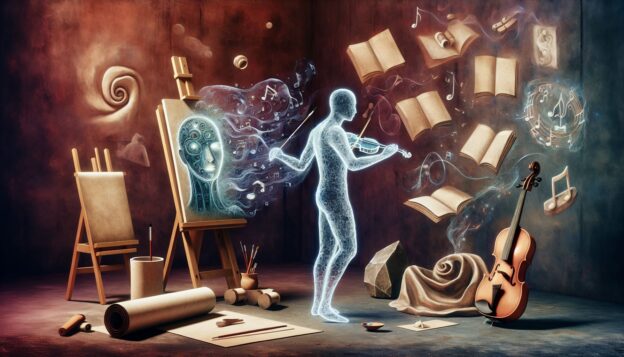
Let me tell you a story about creativity. For centuries, we’ve told ourselves a specific narrative: that art is uniquely human. That it requires a soul, suffering, a spark of divine inspiration. That it emerges from lived experience, from the tremor in a hand holding a brush, from the ache in a heart translating emotion into color.
Then, in 2022, a Colorado game designer named Jason Allen won first place at the Colorado State Fair’s art competition. His piece, Théâtre D’opéra Spatial, was breathtaking—a Baroque-style vision of space opera, all rich textures and luminous details. And it was created using Midjourney, an AI art generator.
The art world exploded. Accusations of “cheating” flew. Artists felt threatened. Commentators declared the death of human creativity.
But what if they’re all missing the point?
AI-generated art isn’t ending creativity. It’s exposing our deepest, most flawed assumptions about creativity. We’re not witnessing the replacement of the artist. We’re witnessing the rebirth of the curator, the director, the creative visionary. The canvas hasn’t disappeared; it’s expanded into the infinite space of human imagination, with AI as our bewildering new brush.
This is the story of how lines of code learned to paint with light, and why that changes everything.
The Great Demystification: How AI Actually “Creates” Art
First, let’s strip away the magic (and the fear). AI art generators like DALL-E 3, Midjourney, and Stable Diffusion aren’t conscious. They don’t “dream” or “imagine” in the human sense. So what are they doing?
The Machine is a Mirror (Made of Math)
Think of these AI models as the world’s most obsessive art student. They’ve been shown billions of image-text pairs—photos, paintings, sketches, each with a descriptive caption. Using a process called diffusion, they don’t just memorize; they learn the deepest statistical relationships between words and visual concepts.
Ask it for “a cat in the style of Van Gogh.” It doesn’t fetch a stored image. It navigates a vast mathematical space of “cat-ness” and “Van Gogh-ness”—the swirling brushstrokes, the bold colors, the specific way he rendered light—and synthesizes something new at their intersection.
It’s a prediction machine. Given this string of words, what pixels are most probable?
The Prompt is the New Paintbrush
This is the crucial shift. For the user, the primary skill is no longer dexterity with a physical tool. It’s linguistic and conceptual precision. This is called prompt engineering.
A beginner types: “a cool spaceship.”
An expert crafts: “A sleek, retro-futuristic starship, landing on an alien moss-covered megastructure at twilight, cinematic lighting, hyperdetailed, Unreal Engine 5, trending on ArtStation, dramatic atmosphere.”
The first gives you a generic clip-art result. The second can produce a masterpiece. The artist’s role has shifted from manual execution to creative direction. You are no longer painting the ship; you are the art director describing it to a miraculously talented, literal-minded assistant.
The Creative Upside: How AI is Liberating Imagination
The backlash focuses on what AI might destroy. But let’s talk about what it’s creating: unprecedented access to visual expression.
Democratizing the Visual Voice
For the first time in history, someone who can’t draw a stick figure can manifest a vivid, complex scene from their mind. A novelist can generate a cover concept. A game designer can prototype character designs in minutes. A marketer on a tight budget can create compelling visuals.
This is a monumental shift in creative equity. The barrier to entry for visual ideation has collapsed. The value is moving from technical skill (which AI can replicate) to taste, vision, and editing (which it cannot).
The Ultimate Brainstorming Partner
Creative block is real. Staring at a blank canvas is terrifying. AI acts as an infinite idea generator. You can start with a vague notion—“melancholy robot in a rainforest”—and then iterate: Make it rain. Now make the robot made of porcelain. Now set it at dawn. Now make the rainforest bioluminescent.
Each iteration sparks new ideas. The AI doesn’t get tired. It becomes a collaborative partner in a rapid, visual conversation, pushing your own imagination into corners you might never have explored alone.
Supercharging Professional Workflows
This isn’t just for amateurs. Professional concept artists, architects, and designers are using AI as a powerful first-draft machine.
- A filmmaker can generate mood boards and style frames in seconds, communicating a visual tone to an entire crew.
- An interior designer can show a client 20 variations of a “mid-century modern living room with green accents” in an hour.
- A product designer can explore hundreds of form factors for a new chair before modeling a single one in CAD.
The tedious, time-consuming part of generating options is automated. The human professional’s expertise is then applied to the highest-value tasks: selecting, refining, and executing the best idea.
The Existential Anxiety: Why Artists Are (Rightfully) Freaking Out
We can’t gloss over the real, visceral fear in the creative community. It’s not just about one Colorado art fair.
The Training Data Dilemma: Genius or Theft?
Here’s the core ethical firestorm. Those billions of images the AI was trained on? They were scraped from the internet, mostly without the consent, credit, or compensation of the original artists. The AI has learned from the collective work of millions of living artists, absorbing their unique styles.
An artist who spent a decade developing a signature visual style can now watch users type “in the style of [Their Name]” and generate passable imitations in seconds. Is this learning, like a human student studying the masters? Or is it theft on an industrial scale? The law is scrambling to catch up, but the feeling of violation in the artist community is profound and legitimate.
The Economic Tsunami
The entry-level commercial art market is facing disruption. Why hire a junior illustrator for $500 to create a blog graphic when you can generate 100 options for $10? Stock photo agencies, basic graphic design, and simple illustration commissions are vulnerable. For working artists, this isn’t a philosophical debate; it’s a threat to their livelihood.
The “Soul” Question
Even if the output is beautiful, is it art? Our cultural narrative ties art to human intention, struggle, and story. A painting is valued not just for its image, but for the story of the artist who made it. What’s the story of an AI-generated image? “I typed some words.” Does that feel hollow? For many, it does. It challenges our very definition of artistic merit.
The New Creative Landscape: Hybrid Humans in the Loop
The future isn’t AI or human artists. It’s AI and human artists, working in a new, hybrid creative loop.
The Four New Creative Archetypes:
- The Prompt Director: The visionary who uses words and iterative refinement to guide the AI, treating it like a tireless production studio. Their art is in the curation and the conceptual brief.
- The Hybrid Painter: Uses AI-generated images as a base or inspiration, then brings them into Photoshop, Procreate, or other tools to paint over, correct, and inject deliberate human imperfection and style. The AI does the underpainting; the human does the finish work.
- The Ethical Model Trainer: Artists who build their own AI models trained exclusively on their own artwork. This creates a personal “style engine” that amplifies their unique voice without appropriating others’.
- The Traditionalist Purist: Chooses to work entirely without AI, leveraging the growing cultural and market value of “100% human-made” as a mark of authenticity and craft.
The Evolving Skillset: What Matters Now?
If AI handles execution, what human skills become more valuable?
- Taste & Curation: The ability to sift through 1,000 AI generations and find the one with the right feeling, the compelling mistake, the spark of magic.
- Conceptual Depth: The ideas, stories, and emotions behind the work. An AI can render a sad clown, but it doesn’t know why the clown is sad. The human provides the meaning.
- Art Direction & Editing: Knowing how to take a 90%-there AI image and make the critical 10% adjustment that brings it to life.
- Intentionality & Narrative: Building the human story around the work. The context of its creation, the artist’s statement, the connection to the human experience.
The Philosophical Earthquake: Redefining “Artist”
This technology is forcing a long-overdue conversation. We’ve romanticized manual skill, but is that truly the core of creativity? Was a film director like Stanley Kubrick less creative because he didn’t operate the camera himself? Is a composer less creative for using a symphony orchestra instead of playing all the parts?
AI art separates the act of conception from the act of execution.
For centuries, they were bundled together in the individual artist. Now, they can be unbundled. This doesn’t eliminate creativity; it refocuses it on the conception phase. The “artist” becomes the one with the vision, the taste, the edit.
The art world’s gatekeepers—galleries, critics, institutions—are in turmoil. How do you judge this? New criteria are emerging: the originality of the concept, the sophistication of the process, the intentionality of the curation.
Conclusion: Not the End of Art, But the End of Art As We Knew It
The invention of the camera didn’t kill painting. It liberated it. Freed from the burden of realistic representation, painting exploded into Impressionism, Abstraction, and Expressionism. The camera took one job (replication) so painting could explore new ones (emotion, abstraction, concept).
AI image generation is the camera moment for the 21st century.
It is taking the job of manual visual synthesis—of rendering a specific scene from a description. This is terrifying for those whose creativity was tied to that specific skill. But it is liberating for human creativity as a whole.
We are being pushed, kicking and screaming, to answer the question: What is uniquely human about our creativity?
It’s not our hands. It’s our hearts, our messy experiences, our cultural contexts, our irrational loves and fears, our ability to mean something. An AI can generate an image of grief, but it cannot know grief. The human artist can. And the human artist of the future will use all tools available—including AI—to translate that knowing into forms the world can feel.
The canvas is now infinite. The paint is now made of language and data. And the artist is no longer just the one who applies the paint, but the one who dares to imagine what could be. The creative act hasn’t been automated. It’s just beginning.
FAQs: Your Burning Questions on AI Art
Q1: Is it ethical to use AI to create art and sell it?
A: It’s a gray area evolving daily. The key is transparency and ethical sourcing. If you’re using a model trained on copyrighted work without consent, selling direct outputs can be ethically problematic. Best practices: 1) Disclose the use of AI. 2) Add significant human modification/editing to claim copyright. 3) Consider using ethically-trained models (trained on licensed or public domain art). 4) For commercial work, ensure your client knows and agrees. The market will increasingly value ethical provenance.
Q2: Can I copyright an AI-generated image?
A: As of now, in the US and many jurisdictions, no. The U.S. Copyright Office has ruled that works created solely by AI without human “creative input” or “direction” cannot be copyrighted. The authorship belongs to no one. However, if a human makes substantial creative modifications to the AI output, that modified version can be copyrighted. The line between “direction” and “generation” is the legal battleground of the next decade.
Q3: Will AI replace all artists?
A: No. It will replace some tasks and certain types of commercial art (like generic stock imagery). But it will create new roles (prompt engineers, AI art directors, hybrid artists) and increase demand for high-concept, deeply intentional, and human-centric art. The artist who can tell a compelling story, connect emotionally, and offer a unique human perspective will become more valuable, not less. It’s a career evolution, not an extinction.
Q4: How can I, as an artist, protect my style from being used to train AI?
A: It’s challenging. Technical solutions like Glaze and Nightshade are emerging. These tools apply subtle, invisible changes to your artwork before you post it online. To an AI scraper, these “poison” pixels make your art look like something else (e.g., a cat instead of a portrait), corrupting the training data. It’s an arms race, but it empowers artists to fight back. Also, building a strong personal brand around your human story makes your “origin” part of the value.